With seven distinct massage styles available through in-room service in Ho Chi Minh City, choosing the right one can feel overwhelming — especially if…
Read moreLower back pain is the single most common reason people seek massage therapy worldwide, and it's especially prevalent among travelers.
Read moreThai massage and deep tissue massage are two of the most popular styles among travelers in Ho Chi Minh City — and two of the most commonly confused.
Read moreYour Safety Matters
Every MassageGo therapist meets strict qualification requirements
All therapists hold professional massage therapy certificates from accredited Vietnamese training programs.
Each therapist completes a minimum of 200 hours of hands-on training before joining our team.
We require at least 3 years of professional massage experience at hotels or licensed spas.
Our therapists can communicate in basic English to ensure a comfortable experience for international guests.
Every therapist goes through our rigorous 4-step screening process
We review professional certifications, training records, and a minimum of 3 years of spa or hotel experience.
Government-issued ID verification and background check to ensure your safety and peace of mind.
Hands-on skills test covering multiple massage techniques, hygiene protocols, and professional conduct.
Regular performance reviews based on customer feedback. Therapists maintain a 4.5+ rating to stay active.
Thai massage is a 2,500-year-old healing system that combines acupressure, assisted yoga stretches, and energy line work. Often called "lazy person's yoga," it improves flexibility and energy flow without any effort on your part.
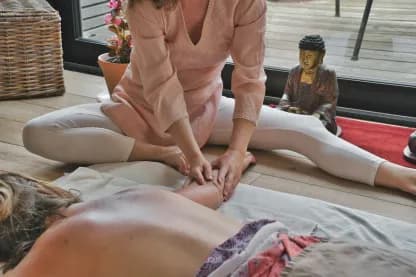
The therapist uses their hands, knees, legs, and feet to move you into a series of yoga-like stretches while applying deep muscle compression and rhythmic pressing along energy lines (sen lines). No oil is used.
Passive stretching moves your joints through their full range — the therapist does the work, nothing required from you
The assisted stretches reach the hip flexors, spine, and posterior chain better than anything you can do on a mat alone
Deep compression plus elongation releases knots that pressure alone can't fully address
The opposite of the sleepy effect from Swedish-style work — most clients feel a surge of energy for hours after
No oil, no prep — the most practical option when you have somewhere to be
Wear comfortable, loose clothing (we provide if needed)
The massage is performed on a padded mat or bed
You'll be moved into various stretching positions
Pressure is applied using hands, elbows, knees, and feet
Communication about pressure intensity is encouraged
Everything you need to know before you book
Thai massage is fully clothed, which simplifies the logistics: no oil, no towels, no shower needed after, and the therapist sets up in under 5 minutes. It can be booked at any hour without the oil-related considerations of other services. Same-day bookings are standard. One practical note: avoid booking immediately after a large meal — the stretching and compression are more comfortable on an empty or light stomach. An hour gap is sufficient. Book via WhatsApp with hotel name, session length, and preferred time.
Thai massage is one of the few services that sees strong morning bookings — guests who want to start the day loose and flexible before sightseeing or meetings. The other popular window is early evening (5–7 PM) for recovery after a full day. The 90-minute session is the most popular choice: long enough to work through a full sequence of stretches, short enough to leave the evening free. First-timers should note that 60 minutes is sufficient for a complete introduction but the 90-minute format allows the therapist to address more areas at a relaxed pace. Late-night Thai massage is available with a 50,000 VND surcharge.
The therapist arrives with a padded mat and any needed supports — setup is 4–5 minutes. No oil is used and you remain fully clothed throughout; wear loose, comfortable clothing. If you don't have any, the therapist can provide suitable clothes. The session involves guided movement: the therapist repositions you through a sequence of stretches and applies compression between stretches. Communicate freely about pressure intensity — the stretches are always adjusted to your current flexibility. After a session, most guests feel energized rather than drowsy. Payment is cash, settled with the therapist after the session.
“The Thai massage was incredible — I felt so much more flexible afterwards. The therapist used proper technique the entire session, none of that tourist-spa rushing. My back and hips had been tight for weeks from the flight; an hour later they weren't.”
Mike T.
Australia
Your Safety Matters
Every MassageGo therapist meets strict qualification requirements
All therapists hold professional massage therapy certificates from accredited Vietnamese training programs.
Each therapist completes a minimum of 200 hours of hands-on training before joining our team.
We require at least 3 years of professional massage experience at hotels or licensed spas.
Our therapists can communicate in basic English to ensure a comfortable experience for international guests.
Every therapist goes through our rigorous 4-step screening process
We review professional certifications, training records, and a minimum of 3 years of spa or hotel experience.
Government-issued ID verification and background check to ensure your safety and peace of mind.
Hands-on skills test covering multiple massage techniques, hygiene protocols, and professional conduct.
Regular performance reviews based on customer feedback. Therapists maintain a 4.5+ rating to stay active.
Pay cash (VND) after your session — the price you see is the price you pay
No. Thai massage requires no existing flexibility — in fact, it is specifically designed to improve flexibility in people who have very little. Our therapists work within the natural range of motion of your joints and muscles, applying only as much stretch as your body allows comfortably at that moment. Every movement is passive, meaning you do not engage your muscles to hold positions — the therapist does all the work. Clients who describe themselves as completely inflexible often find Thai massage more beneficial than those who are already flexible, because the gentle assisted stretching creates gradual improvements over repeated sessions. If you have specific joint issues, injuries, or surgeries, please inform your therapist before the session begins so stretches to that area can be avoided or modified.
Thai massage should not be painful. You may experience moments of intensity — a deep compression on a tight muscle group or a stretch that reaches your current range-of-motion limit — but this should feel like productive pressure rather than pain. The key is communication with your therapist throughout the session. Our therapists regularly ask for feedback and will adjust pressure, depth, and stretch intensity based on your response. A common sensation clients describe is 'good hurt' — discomfort that immediately releases into relief. If anything feels sharp, burning, or genuinely painful, tell your therapist immediately and they will stop or modify the technique. Clients with chronic pain or previous injuries should mention these before the session begins.
Thai massage is performed fully clothed, so your clothing choice directly affects the comfort of your session. Loose, lightweight clothing works best — yoga pants, sweatpants, or loose linen trousers, paired with a t-shirt or loose long-sleeved top. Avoid jeans, tight athletic wear, belted trousers, or anything restrictive around the hips, knees, or shoulders, as these limit the range of stretching movements. Avoid wearing a dress or skirt. If you arrive without appropriate clothing, your therapist can provide comfortable session wear at no charge — just mention this when booking so we can prepare. Remove jewellery, watches, and any accessories before the therapist arrives, as these can interfere with the massage and may get in the way during stretching sequences.
We don't list sports massage as a separate service, but Thai massage covers everything sports massage addresses. Thai uses the same compression, assisted stretching, and targeted pressure on loaded muscle groups — applied across the full kinetic chain: hip flexors, IT band, hamstrings, calves, and thoracic spine. We recommend it for runners, gym-goers, and cyclists wanting post-workout recovery, pre-event prep, or injury prevention. 90 minutes is best for full athletic recovery.